AI/ML for Trading: When It Helps, When It Hurts
A pragmatic framework for deciding if ML belongs in your strategy and how to validate it safely.
Machine learning promises to find patterns humans can't see. In trading, that promise has a mixed track record. Academic papers routinely report strategies with double-digit annual returns, yet institutional practitioners estimate that over 90% of ML-based strategies fail when deployed with real capital. The gap isn't because ML doesn't work — it's because most applications violate basic principles of time-series validation, overfit to noise, or solve the wrong problem.
When ML genuinely helps
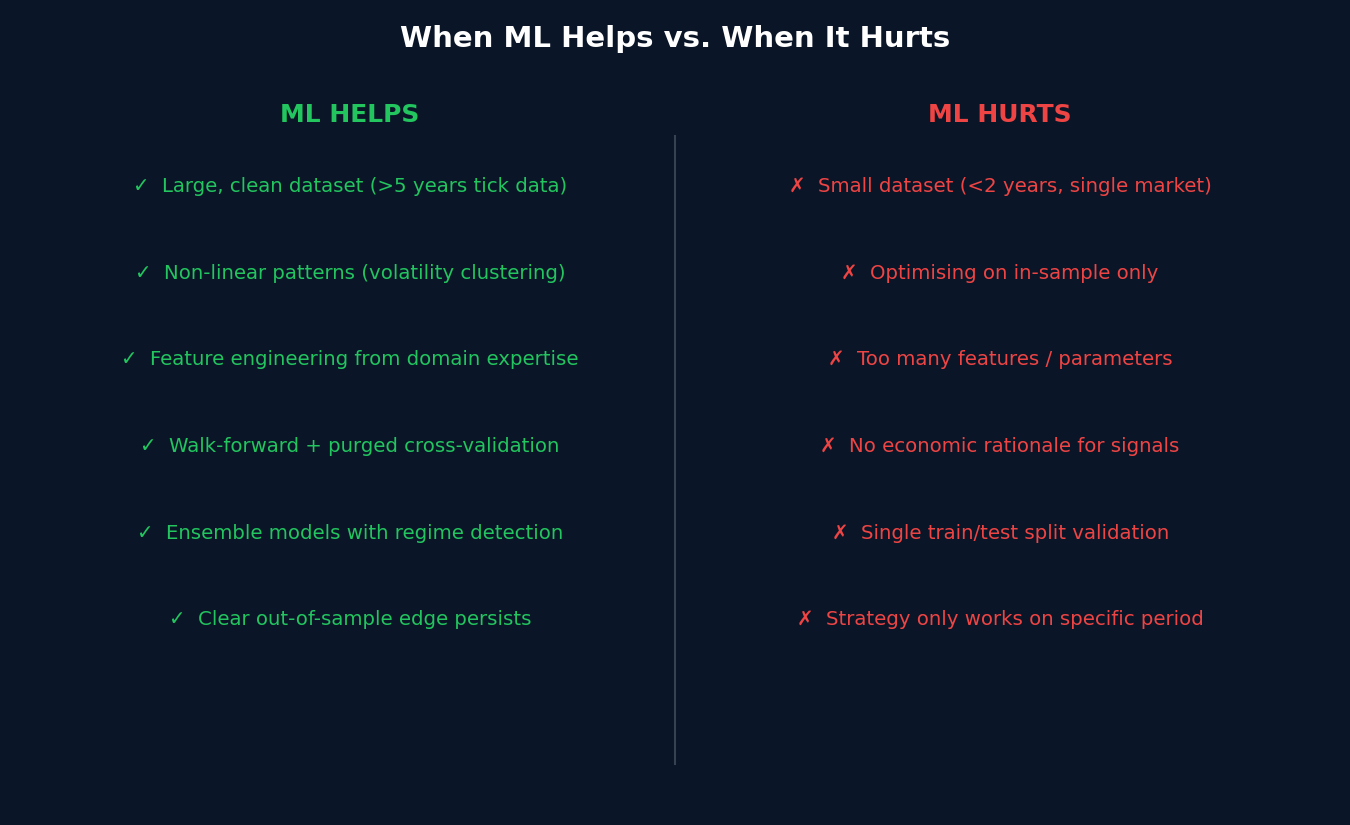
ML works in trading when it's applied to problems with genuine non-linear structure that rule-based approaches can't capture efficiently. Research shows that tree-based and neural network models can substantially outperform linear models in measuring equity risk premia — in some cases doubling Sharpe ratios. But these results come with important caveats.
- •Regime detection: Identifying whether the current market is trending, mean-reverting, or choppy. A Hidden Markov Model or clustering approach can adapt strategy parameters to the current regime, reducing drawdowns during unfavourable conditions.
- •Volatility forecasting: GARCH variants and recurrent networks can improve volatility estimates beyond simple historical measures, leading to better position sizing and risk management.
- •Feature filtering: Using ML to rank or select which technical/fundamental signals are currently predictive, rather than using a fixed set. This is an "ML as filter" approach that enhances a rule-based core.
- •Execution optimisation: Predicting short-term price impact, optimal order timing, and fill probability. This is where ML has the strongest track record because the signal-to-noise ratio is relatively high and feedback loops are fast.
- •Alternative data processing: Extracting structured signals from news, social media sentiment, satellite imagery, or supply chain data. NLP and computer vision have genuine advantages here over manual processing.
When ML hurts
The most dangerous ML applications are those that appear to work in backtesting but fail live. The core problem is almost always the same: the model learned patterns in the training data that don't generalise to new data. In financial time series, this is especially treacherous because markets are non-stationary — the patterns that existed in 2020 may not exist in 2025.
- •Insufficient data: ML models need thousands of independent samples to learn robust patterns. A strategy trading daily signals on a single instrument has only ~250 samples per year. Five years gives you 1,250 samples — barely enough for a simple model, nowhere near enough for a deep network.
- •No economic rationale: If you can't explain why a feature should predict returns, the model is probably fitting noise. "The model found that the 37th lag of the RSI on Wednesdays is predictive" is a red flag, not a discovery.
- •Standard cross-validation: Using k-fold cross-validation on time-series data creates look-ahead bias. Future data leaks into training through temporal autocorrelation. You must use walk-forward or time-series-specific validation.
- •Too many features: With enough features, any model can find spurious correlations. If you have 200 features and 1,000 samples, overfitting is almost guaranteed regardless of regularisation.
- •Single validation period: Testing on one out-of-sample period proves nothing. The model might have been lucky. You need multiple non-overlapping out-of-sample windows.
The right way to validate: walk-forward analysis
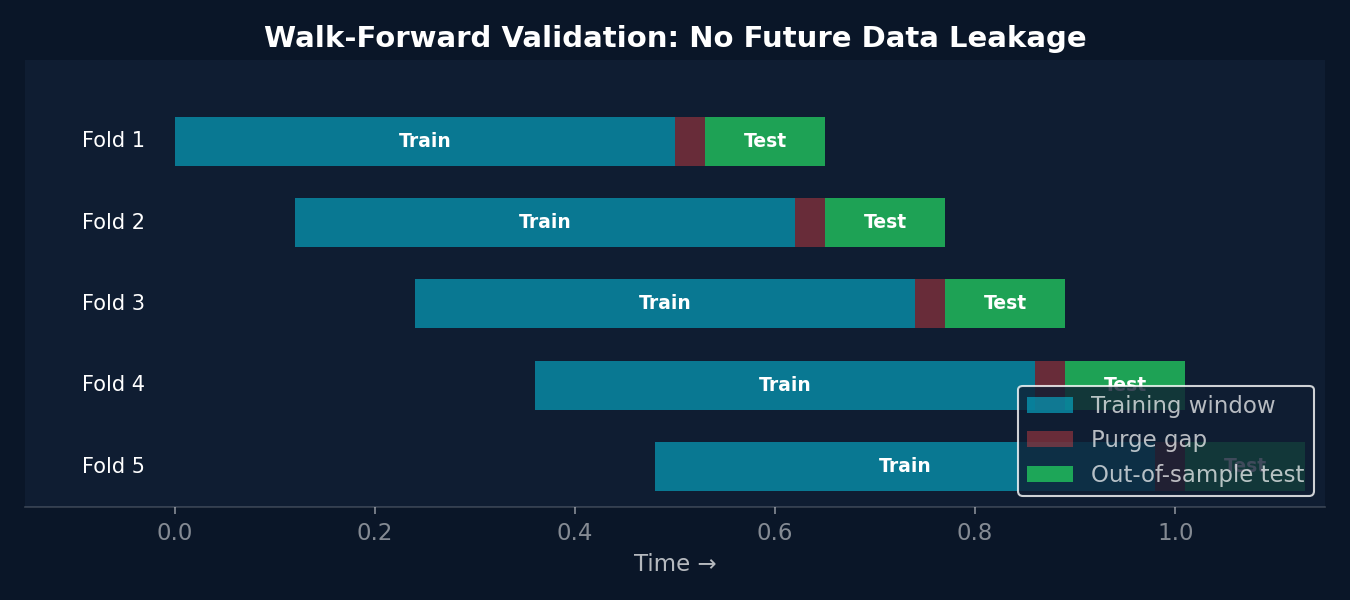
Walk-forward validation is the minimum standard for any ML trading strategy. The process works as follows: train on a historical window (e.g., 3 years), skip a purge gap (e.g., 5 days to avoid autocorrelation leakage), then test on the next unseen window (e.g., 6 months). Roll the entire process forward and repeat. The combined out-of-sample results across all folds represent your realistic performance estimate.
More advanced practitioners use Combinatorial Purged Cross-Validation (CPCV), which generates multiple train/test combinations from the same data, providing a distribution of out-of-sample performance rather than a single point estimate. Research shows CPCV significantly reduces the probability of backtest overfitting compared to standard methods.
A practical decision framework
Before adding ML to a trading strategy, answer these questions honestly:
- •Does a simpler rule-based approach work? If yes, use it. ML adds complexity, maintenance burden, and failure modes. Only use it when rules can't capture the pattern.
- •Do you have enough data? At least 5 years of clean data for the target instrument, with the signal frequency providing at least 2,000 independent samples.
- •Can you explain the features? Every input should have an economic rationale. "Price momentum," "volatility clustering," and "mean reversion after extreme moves" are valid. "The 14th PCA component of 200 random indicators" is not.
- •Can you afford to validate properly? Walk-forward validation requires enough data for multiple non-overlapping train/test cycles. If you only have 3 years of data, you can't do meaningful walk-forward testing.
- •Do you have a monitoring plan? ML models degrade over time as market conditions change. You need automated monitoring for feature drift, prediction accuracy, and strategy performance — with clear criteria for when to retrain or shut down.
If an ML model improves your Sharpe ratio by less than 0.3 compared to the best rule-based version, the added complexity probably isn't worth it. The maintenance burden, retraining pipeline, and additional failure modes of an ML system need to be justified by a meaningful performance improvement.
Key takeaways
- •ML is a tool, not a strategy. It works best when it enhances a sound trading thesis, not when it replaces one.
- •Validation is everything. Walk-forward analysis with purged gaps is the minimum standard. Single train/test splits prove nothing.
- •Start simple. Use ML for feature selection or regime detection before trying end-to-end price prediction.
- •Monitor relentlessly. Every ML trading system needs automated drift detection and performance monitoring with clear shutdown criteria.
- •Be honest about data limitations. If you don't have enough independent samples for proper validation, don't use ML — use rules.